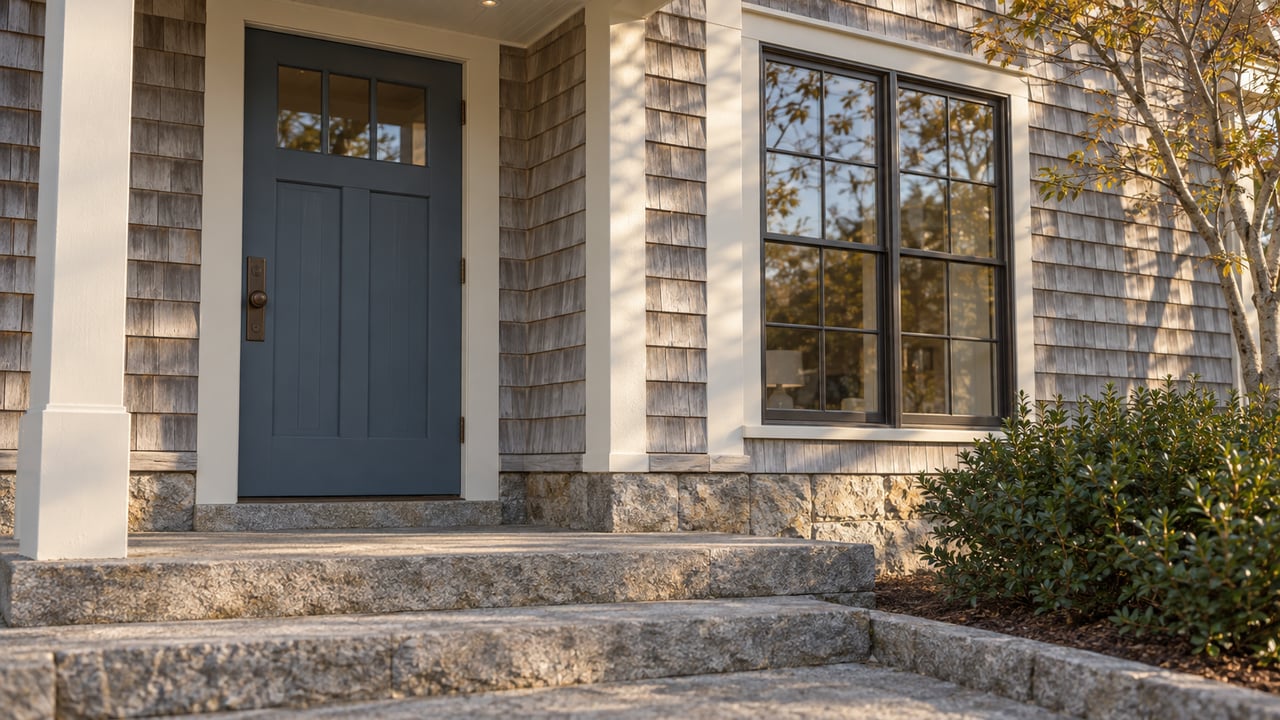
Jamestown's 83-Cent Bridge Toll Explains More Than the Commute
October 1, 2026
October 1, 2026
A buyer closes on a house in Jamestown, hires a painter, schedules an inspector for a punch-list item, and drives back and forth to Newport a dozen times in the first three weeks while movers, contractors, and the closing attorney's office all pull them across the Newport Pell Bridge. Every one of those crossings costs $6, or $4 if the car already has an E-ZPass from another state. The house is theirs. The discount isn't, not yet.
The Newport Pell Bridge is Rhode Island's only toll facility, and it happens to sit on Jamestown's side of the bay, with the Rhode Island Turnpike and Bridge Authority's own business office parked right next to the toll plaza. A Rhode Island resident running a RITBA-issued E-ZPass pays 83 cents per crossing. Everyone else pays $4 with a transponder or $6 billed by license plate. That gap, confirmed in RITBA's own June 2025 rate notice, is close to an 86 percent discount, and it doesn't activate on the day the deed records. It activates on the day RITBA has your paperwork.
RITBA's Resident Discount Plan requires proof of Rhode Island residency before the 83-cent rate applies to your transponder. The accepted documents are a Rhode Island driver's license, a utility bill, a signed lease or mortgage agreement, tax documents, or a recent bank statement, all showing a Rhode Island address. A P.O. box doesn't count. A signed purchase and sale agreement doesn't count either, because it isn't proof you live there yet.
That timing gap matters more in Jamestown than almost anywhere else in the state, because so much of what a new homeowner needs during the first month, contractors, inspectors, permit offices, closing attorneys, sits across the bridge in Newport. Twenty crossings at $6 each is $120. The same twenty crossings at 83 cents is $16.60. It's not a number that breaks a home purchase, but it's a real cost that shows up in exactly the weeks when a household is already juggling movers, deposits, and utility transfers, and it's one that a little advance paperwork erases entirely.
RITBA also runs a stricter payment clock than most people expect. If a crossing gets billed by plate because a transponder wasn't yet active, the 14-day window to pay starts on the date of the crossing, not the date the invoice arrives. Miss it and a $40 fine gets added on top of the toll. For a household mid-move, juggling forwarded mail, that's the kind of detail worth handling before the moving truck shows up rather than after.
Jamestown sits on Conanicut Island, connected to the mainland on its west side and to Newport on its east side, and the toll only ever applied to the eastern crossing. Before 1969, Jamestown residents already had a free bridge to the mainland over the west passage. Getting to Newport meant a ferry. When the Pell Bridge opened in June 1969, replacing that ferry with a suspension span, it didn't just shorten the trip, it restructured who lived on the island and how they used it. Jamestown had been what Wikipedia's history of the bridge describes as a summer-resident town, with a third of its homes owned by seasonal residents. After the bridge, it became a place people commuted from, with local commerce shifting to depend more on visitors from off-island.
That history explains a detail easy to miss when comparing Jamestown to Newport on price alone: the toll was never a tax on leaving the island. It was, and still is, specifically a tax on the relationship with Newport. Grocery runs, big-box shopping, and the highway network toward Providence all run west, toll-free, regardless of residency status. The 83-cent discount only changes the math on the side of the island that connects to Newport's restaurants, marinas, hospital, and cultural calendar.
Once a resident's transponder is active, the cost of treating Newport as an extension of daily life drops to almost nothing. A commuter making two trips a day pays $1.66 instead of $12, a difference RITBA's own account materials put at over $50 a week. For anyone crossing that often, RITBA's Unlimited Travel Plan offers infinite crossings within a rolling 30 days for $40 a month, a plan that pencils out for a resident making more than 48 trips a month, which is easy to hit for a household with school runs, work commutes, and a social life that treats both sides of the bridge as home turf.
That cheap crossing is part of why Jamestown's own commercial footprint has stayed small. Narragansett Avenue functions as the village's main street, with small-scale dining and shops serving a community that doesn't need to replicate Newport's restaurant scene or marina infrastructure on its own side, because Newport is a 10 to 15 minute, 83-cent trip away once the paperwork clears. Larger lots, conservation-minded zoning, and limited commercial development are choices Jamestown has made partly because it never had to build a version of Newport at home.
That's the piece worth sitting with when comparing what a dollar buys on either side of the bridge. In closed sales tracked by the region's multiple listing service this year, a 988-square-foot Cape Cod cottage on Ocean Avenue in Jamestown sold for $1.4 million, a Colonial on East Shore Road with roughly 2,467 square feet sold for $1.15 million, and a Victorian on Cole Street with 1,344 square feet sold for $1.149 million. A one-level condo on Eastnor Road in Newport, by contrast, sold for $960,000 at 1,272 square feet. Jamestown's premium isn't buying more house. In the Ocean Avenue sale, it's buying less square footage for nearly half a million dollars more than the Newport condo.
The Zillow Home Value Index for Jamestown's 02835 zip code put the average home value at $1,221,403 as of its June 2026 update, up 9.7 percent over the previous year, a pace that outstrips the county context around it. Statewide, the median sold price across all residential properties was $519,000 in August 2026, and Newport County properties sold for about 98 percent of asking price that same month, a sign that buyers have gained some room to negotiate even as prices in Jamestown specifically keep climbing on limited inventory. When the numbers are this far apart within the same county, the gap is telling you something about land, lot size, and scarcity rather than square footage.
The fix for the toll gap costs nothing but a little lead time. A buyer under contract on a Jamestown home can gather the documents RITBA accepts, a Rhode Island driver's license, a utility bill showing the Rhode Island address, or a signed lease if renting in the interim, before the closing date rather than after the moving truck arrives. Applying for the RITBA E-ZPass and submitting proof of residency as early as the paperwork allows means the 83-cent rate can be active by the time the first contractor needs to cross the bridge, not three weeks into the unpacking.
It's a small piece of a much larger move, but it's the kind of detail that only shows up once you've walked a few buyers through it, and it sits right alongside the bigger question worth asking before comparing Jamestown to Newport on price: what you're paying for on the island isn't distance from Newport's amenities, it's privacy and land with Newport still 83 cents away.
Does the resident toll rate start automatically when I close on a Jamestown house? No. RITBA requires proof of Rhode Island residency, such as a driver's license, utility bill, or signed lease, submitted to your E-ZPass account before the 83-cent rate applies. A purchase and sale agreement alone isn't accepted.
I already have an E-ZPass from another state. Does that work on the Pell Bridge? It works, but at the non-resident rate of $4.00 per crossing rather than the $0.83 resident rate. Only a RITBA-issued transponder linked to a Rhode Island residency plan qualifies for the discount.
Does my toll status affect trips toward Providence or the mainland? No. The toll only applies to the Newport Pell Bridge on the island's east side. The bridge connecting Jamestown to the mainland on the west side has never been tolled, so commutes toward North Kingstown, Route 1, and Providence aren't affected by residency status.
Understanding a market means understanding its friction points, not just its median price, and if you're weighing Jamestown against Newport or any other coastal Rhode Island town, that's the kind of groundwork Fran Bidell works through with clients before an offer ever gets written. Let's Connect.
This article is general information, not legal, tax or financial advice. Consult a qualified professional about your situation.
Stay up to date on the latest real estate trends.



Connect with a real estate professional who values trust, insight, and personal attention. Every step is guided by a deep understanding of what “home” truly means.
Get In Touch With Our Team To Learn More
Fran Bidell
ADDRESS 28 Caswell St Ste 100 Narragansett, RI 02882